How far apart are Sonoma and Napa?
Downtown Sonoma to downtown Napa is about 14 miles and a 20-24 minute drive, close enough to combine both wine regions in a single day. Here is the full distance picture and how to plan it.
How far apart are Sonoma and Napa?
Downtown Sonoma (Sonoma Plaza) to downtown Napa is about 14 to 14.3 miles, and the drive typically takes 20 to 24 minutes via CA-12 and Napa Road, a short enough hop that one driving guide explicitly calls the route workable for a single day covering both regions. That is the number that surprises people. Two of America's most famous wine regions sit close enough that a morning tasting in Sonoma and an afternoon in Napa is a genuinely ordinary itinerary, not a marathon. The routing is short, the roads are conventional two-lane and four-lane highways, and traffic delays on this corridor are measured in minutes rather than hours.
The catch is what "Sonoma" and "Napa" each actually mean on a map. Sonoma is the town and plaza at the southern end of Sonoma Valley; Napa is the city at the southern end of Napa Valley. Both are the gateway anchors of their regions, and the 14-mile gap between them is the narrow waist where the two valleys pinch together before they fan out again in opposite directions. Drive north from either town and the distances grow fast. Sonoma to Healdsburg, deep in northern Sonoma County, is roughly 45 miles and about 54-55 minutes. Sonoma to Santa Rosa is about 22 miles and 37-42 minutes. So the honest answer has two layers: the downtowns are neighbors, while the wine countries behind them are large and only partly overlapping.
A practical mental model is a tuning fork. The two prongs, Sonoma Valley and Napa Valley, touch at the base near San Pablo Bay and diverge as you go north. If your day stays near the base, everything is close. If you want Russian River Valley Pinot Noir in the morning and St. Helena Cabernet in the afternoon, you are crossing a much bigger map, and the 14-mile headline stops being the relevant number.
The measurements above come from mapping and distance sources, including the Sonoma Valley visitor FAQ, which cites the approximately 22-minute drive between the two downtowns. For anything time-sensitive, like catching a tasting reservation, add a buffer for peak-period traffic on CA-12 and Highway 121, which can slow the corridor without ever making it genuinely long. The 2025 tasting-fee gap between the two counties is covered in detail later in this article, and it shapes the distance decision as much as the mileage does.
Can you do Sonoma and Napa in one day?
Yes, you can do Sonoma and Napa in one day, since the drive between downtowns is only about 14 miles and takes roughly 20 to 24 minutes. Combined itineraries are common and workable, especially if you have a driver handling the transfers between wineries so you can relax and enjoy the tastings. The format matters more than the distance, though. A one-day combo works best when it anchors to the southern halves of both valleys, uses a driver or a tightly planned self-drive route, and caps the winery count at two or three total rather than trying to compress a full day in each region.
The math is straightforward. A typical tasting appointment runs 60 to 90 minutes, and two wineries per day is the widely cited sweet spot for enjoying them, with three as the ambitious maximum before palate fatigue and clock-watching set in. With a 10 a.m. start in Sonoma, one midday tasting near the Plaza, lunch, the 20-something-minute transfer, and a mid-afternoon stop in Napa or Carneros, you get a full, unhurried day that touches both regions. What does not work is pairing a northern Sonoma base with a northern Napa destination, or stacking four appointments across both counties, which turns the day into logistics instead of tasting.
The Carneros region is the quiet hero of the combined day. It sits astride the county line between the two towns, so a Carneros sparkling-winery stop is a natural hinge: last Sonoma-side moment and first Napa-side moment at once. Several operators build exactly this shape into their itineraries, and Sonoma Wine Tours covers the same corridor in its tour roundups.
The strongest version of the one-day plan is a private driver, because the transfer is short but you will be tasting in both counties and someone has to hold the wheel. The 8-Hour Private Sonoma or Napa Wine Tour, Concierge XL SUV is built for precisely this question: a full-day private charter in an XL SUV, rated 4.9 across 144 reviews (checked September 2026), at a firm from $449 per group (checked September 2026), with the routing choice between Napa and Sonoma in your hands. A private concierge-format day is the only style where the 14-mile gap becomes a genuine asset rather than a compromise, since the driver absorbs the scheduling, the parking, and the post-tasting drive back.
If a full-day private charter is more budget or commitment than your trip allows, the same question has lighter answers, from join-in group tours inside one county to a simple self-drive day built around the Carneros hinge. The next section maps out where the real distances pile up, and the tour formats section at the end breaks down which roster options actually cross the county line versus which stay put.
How far is Sonoma from Napa's wine country beyond downtown?
The distance grows quickly once you leave the two downtowns: Sonoma to Healdsburg is roughly 45 miles (about 54-55 minutes), Sonoma to Santa Rosa about 22 miles (37-42 minutes), and Napa's upper-valley towns like St. Helena add comparable mileage north from Napa city, so the 14-mile headline only describes the southern anchors. Anyone planning tastings in the northern appellations of either county is really planning two separate trips with a long connector in the middle.
This is where the tuning-fork geography bites. Sonoma County covers roughly 1,576 square miles with 19 AVAs and more than 425 wineries, while Napa Valley is far more compact, a strip of roughly 395 square miles in one commonly cited measurement. Sonoma is roughly twice the size of Napa County in land area and spreads its wineries across valleys that do not always connect efficiently. Dry Creek Valley, Russian River Valley, and Alexander Valley cluster around Healdsburg in the north; Sonoma Valley and Carneros sit in the south near the town of Sonoma. Crossing from one cluster to the other within Sonoma alone can take close to an hour.
| Route | Distance | Typical drive time |
|---|---|---|
| Downtown Sonoma to downtown Napa | ~14-14.3 miles | 20-24 minutes |
| Downtown Sonoma to Santa Rosa | ~22 miles | 37-42 minutes |
| Healdsburg to Santa Rosa | ~15-16 miles | 19-25 minutes |
| Healdsburg to Sonoma (town) | ~36-45 miles | 45-60 minutes |
| Sonoma to Healdsburg | ~45 miles | 54-55 minutes |
Route distances are fixed facts from mapping sources; actual times vary with Highway 101 and CA-12 traffic, worst on Friday afternoons and summer weekends. The Healdsburg-to-Sonoma span deserves special respect: it is the trip people underestimate most, because both ends are "Sonoma," yet the drive between them crosses most of the county. If your lodging is in Healdsburg and your first tasting is near Sonoma Plaza, plan for nearly an hour on the road before the first pour. For travelers weighing the two towns as trip bases rather than regions, the Healdsburg or Sonoma comparison breaks down the vibe, walkability, and appellation access of each.
What does the drive between Sonoma and Napa actually look like?
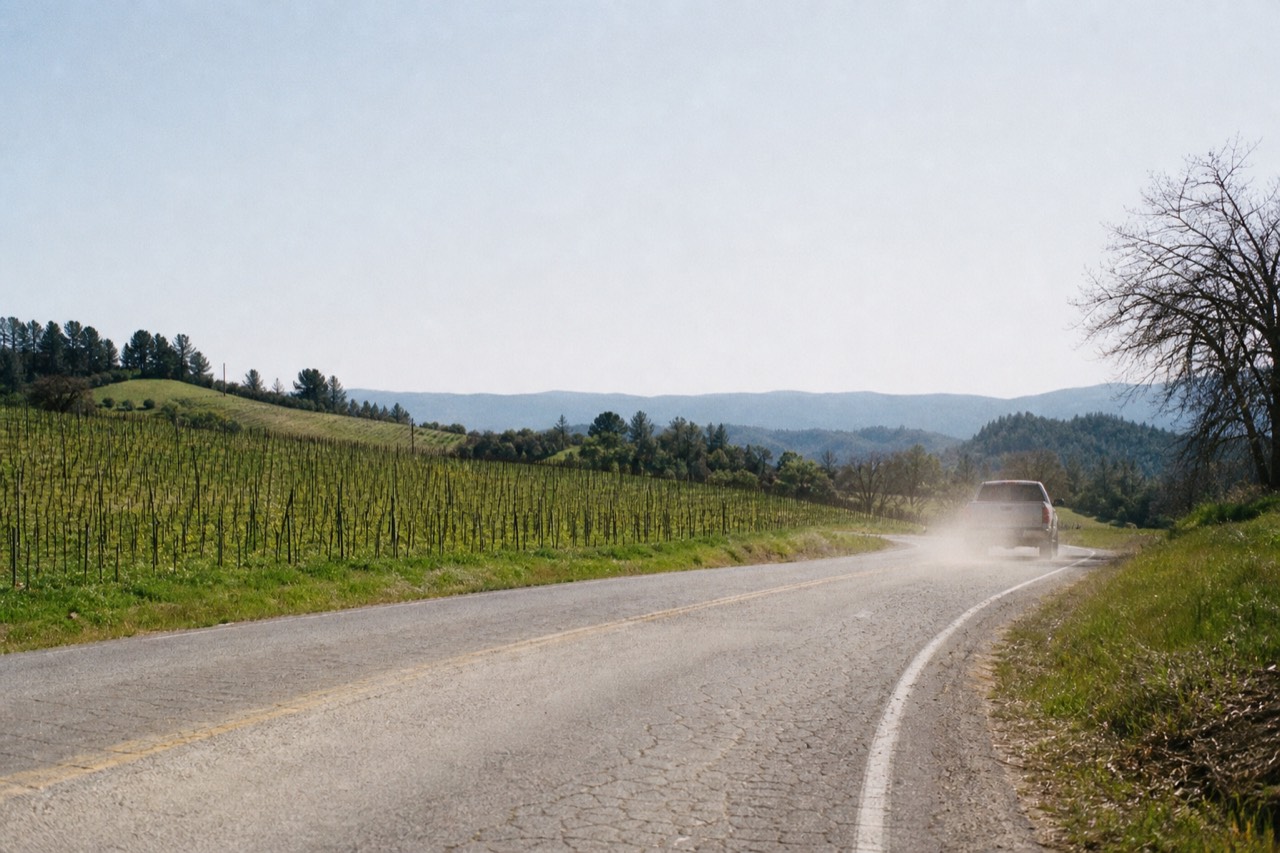
The Sonoma-to-Napa drive is a short, easy route on ordinary highways, roughly 20-24 minutes via CA-12 and Napa Road, passing through the Carneros lowlands where both counties' cool-climate vineyards begin, and it is not a mountain crossing or a winding canyon road. It is a working commute corridor between two wine-country towns, flat to gently rolling, with vineyard views for most of the way and normal rural-highway speeds end to end.
The character of the route is part of why combined trips work. You leave Sonoma Plaza, cut across the southern flats past Carneros wineries and grazing land, and drop into the city of Napa from the south. Along the way you pass some of the most historically important sparkling-wine and Pinot Noir ground in California, since Carneros is the shared appellation that straddles the county line. Drivers should expect the usual peak-period slowdowns, especially Friday afternoons and weekend middays, when tasting-room traffic thickens on CA-12 and Highway 121; the delay is measured in minutes, not hours.
One honest caveat for self-drivers: the short distance makes the drive easy and also makes it easy to forget that you are tasting in both counties before getting behind the wheel twice. California's per-se DUI threshold is 0.08% blood alcohol for a regular driver, lower at 0.04% for commercial drivers, per Vehicle Code section 23152. Tastings add up faster than drive time suggests, and this is the practical argument for the driver-led formats covered below.
Is it cheaper to base yourself in Sonoma or Napa?
Sonoma is consistently cheaper as a base: Sonoma County's average daily room rate ran around $207 (checked September 2026) in mid-2025 reporting, while Napa County's climbed from roughly $412 in 2024 toward about $440 in 2025 data, with peaks above $500 in some months, nearly doubling the nightly cost before tasting fees even enter the picture. On top of that, Napa's median basic tasting fee rose 15% to about $75 against Sonoma's roughly $40 median (checked September 2026).
The tasting-fee gap matters as much as lodging. In 2025, Sonoma County's median basic tasting flight held near $40 while elevated experiences jumped to a median of $90, a 44% increase; Napa's baseline moved to a median near $75 with elevated experiences around $150 (checked September 2026). Two people doing two standard tastings in each county on a combined day can easily spend double on the Napa side for the same number of pours. On top of that, tasting-room traffic fell 18% in Napa County in 2025 versus an 8% dip in Sonoma, so the busier-feeling rooms are more likely to be on the Sonoma side of the line. The Press Democrat reported those traffic and fee figures in May 2026.
For a one-day combined trip, the lodging question mostly reduces to: sleep on the Sonoma side, spend the morning there, and let the cheap 20-minute drive deliver you to Napa for the afternoon. The fuller cost breakdown, including the 2026 fee data behind these ranges, is in our article on whether it is cheaper to stay in Napa or Sonoma.
Which tour formats make the most of the short distance?
Private and join-in tours both exploit the 14-mile gap well, but differently: a private full-day charter lets you genuinely split the day between counties, while a join-in group tour keeps you inside one county and wins on per-person price. The distance is short enough that an operator can cover both regions in a standard eight-hour day without highway fatigue, which is exactly what the private concierge formats are designed around.
On the private side, two roster options fit. The 8-Hour Private Sonoma or Napa Wine Tour, Concierge XL SUV, rated 4.9 across 144 reviews and from $449 per group (checked September 2026), is the driver-led version of the combined day. Its sibling, the Napa and Sonoma Private Wine Tour with Custom Itineraries, also runs about eight hours, is rated around 4.6 across 50 reviews (a midpoint of a 4.5-4.7 spread across reads), and carries its price on the listing rather than as a confirmed figure; its draw is building a custom Napa/Sonoma route stop by stop. Custom-itinerary planning matters here because the region pair you choose determines whether your day hugs the 14-mile waist or sprawls across two counties.
On the join-in side, the Sonoma County Join-In Group Wine Tasting Tour is the featured half-day format: rated 4.9 across 160 reviews, from $147.99 per person (checked September 2026), visiting three Sonoma County wineries with transport and hotel pickup in Sonoma or Santa Rosa, tasting fees extra. It will not cross into Napa, but it is the value benchmark a combined private day gets measured against, and for many travelers one well-run county day beats a rushed two-county sprint. For the underlying price landscape, the best Sonoma wine tours roundup compares the full roster of formats side by side.
The short version: downtown Sonoma and downtown Napa are about 14 miles and 20-24 driving minutes apart, close enough for a combined one-day itinerary, while the wider wine countries behind them stretch in opposite directions and change the math depending on where you anchor. The questions below cover the specifics travelers ask most.
Common questions about Sonoma and Napa distances
How far apart are Sonoma and Napa?
Downtown Sonoma to downtown Napa is about 14 to 14.3 miles, typically a 20 to 24 minute drive via CA-12 and Napa Road. The two wine regions behind the towns are much larger and only partly close: Sonoma County alone spans 19 AVAs and more than 425 wineries.
Can you do Sonoma and Napa in one day?
Yes. The 14-mile, 20-24 minute drive between downtowns is short enough that combined one-day itineraries are common and explicitly workable, especially with a private driver. The best format anchors to the southern halves of both valleys and caps the day at two or three wineries total.
Is Napa or Sonoma closer to San Francisco?
Both are roughly an hour's drive from San Francisco under normal conditions, about 44-45 miles to Sonoma Plaza via Highway 101 and the Golden Gate Bridge. Peak traffic on Friday afternoons and weekends can add substantial time to either route.
Is it cheaper to stay in Sonoma or Napa?
Sonoma. Sonoma County's average daily room rate was reported near $207 in mid-2025, while Napa County's ran from roughly $412 in 2024 toward about $440 in 2025 data. Napa's median basic tasting fee, about $75, also sits well above Sonoma's roughly $40 (checked September 2026).
Which towns in Sonoma County are farthest from Napa?
Healdsburg, in northern Sonoma County, is the big one: roughly 36-45 miles from the town of Sonoma and about 45-55 minutes by car, before you even reach Napa. Trips anchored in Healdsburg or the Russian River Valley generally should not be combined with a Napa day.